09/29/2026
As the SAT Turns 100, Nearly 2 Million Students in the Class of 2026 Take the Test
The SAT Suite reached more than 6 million students during the 2025-26 school year
The 2026 SAT® Suite of Assessments Annual Report released today shows that nearly two million students in the high school class of 2026 took the SAT at least once, reflecting consistently strong participation in the assessment as it marks its 100th anniversary. Scores rose for the second consecutive year, showing signs of continued recovery from pandemic-era declines. Combined with strong PSAT-related assessment participation, the SAT Suite reached more than six million students during the 2025-26 school year.
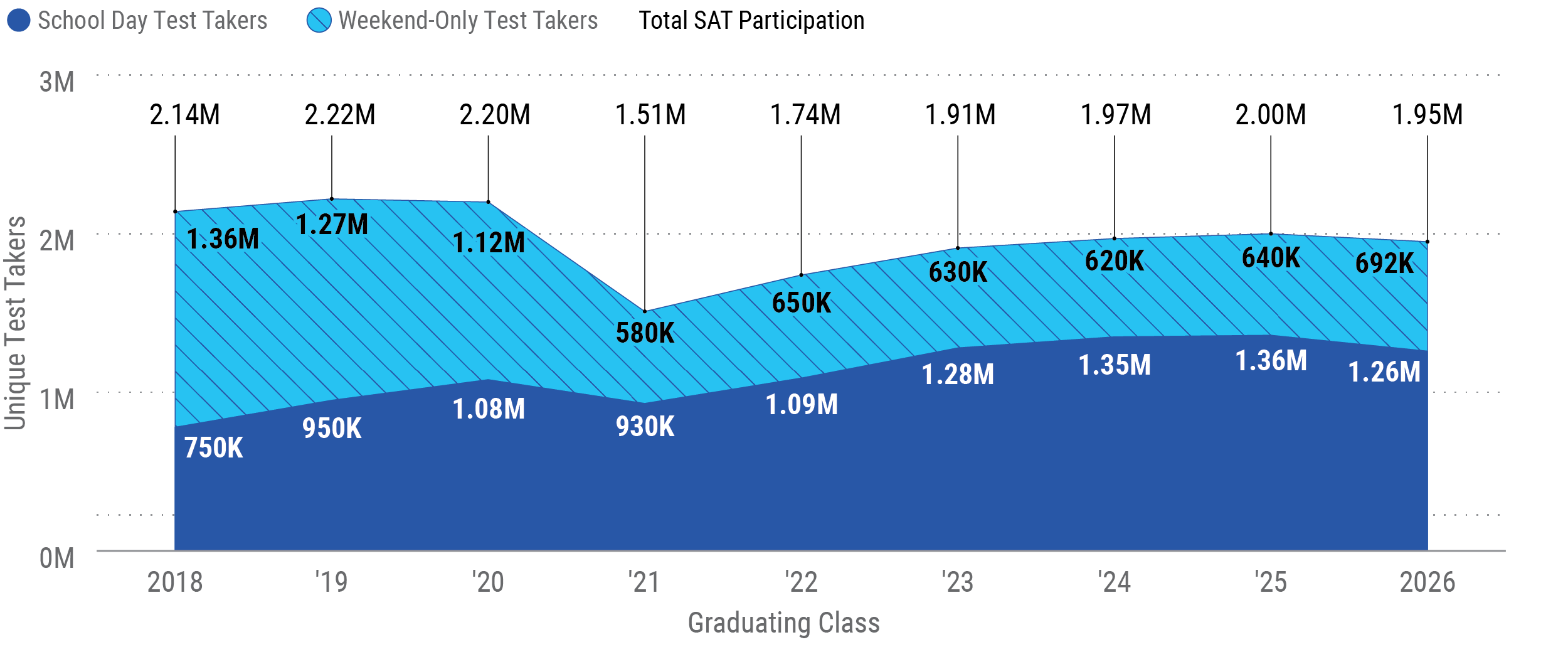
Overall, more than 1.95 million students in the class of 2026 took the SAT, a modest 2.5% decrease from the class of 2025 and the first decrease in participation since the pandemic-affected class of 2021. In most areas, the SAT continued to grow, with participation increasing from last year in 42 states and the District of Columbia, and international SAT participation rising 13.5%, reflecting continued growth in global reach.
“As the SAT marks its 100th year, we continue to focus on ensuring students have access to the many opportunities the SAT and PSAT-related assessments provide, including scholarships,” said Priscilla Rodriguez, senior vice president of College Readiness Assessments at College Board. “Knowing that more than six million students accessed those opportunities last year, also while average scores increased, speaks to our mission as a nonprofit focused on helping students navigate a life of opportunity after high school—whether their path leads to college, career training, or directly into the workforce. The skills the SAT measures are the skills employers and training programs demand, and it remains one of the clearest, most consistent ways for a student to show what they're capable of, no matter where they live or go to school."
SAT Weekend Growth and SAT School Day
Participation in SAT Weekend grew for the second straight year, both in the number of students tested and as a share of the total cohort. That growth was made possible by the thousands of schools and local communities across the U.S. and around the world that partnered with us to open their doors as test centers, enabling 2.1 million SAT Weekend tests this year. Growth was especially strong outside the United States, where the SAT increasingly serves as a passport to higher education opportunities worldwide—a single, trusted credential that travels with students wherever they choose to apply.
SAT School Day accounted for 65% of SAT takers in the class of 2026, with more than 10,000 schools offering the program during the 2025-26 school year. Though participation decreased slightly from last year due to some statewide testing shifts, the widespread use of the program continues to emphasize the important role school-day testing plays in providing broad access to the SAT. SAT School Day provides schools, districts, and states a way to offer the SAT to juniors and seniors during the school day, often at no cost to students.
Mean SAT Scores
The mean total SAT score for the class of 2026 was 1045, a 16-point increase over the class of 2025 and the second consecutive year of score gains, with increases across all demographic groups. Average scores rose in both sections: Reading and Writing scores increased 7 points to 528, returning to pre-pandemic levels, while Math scores improved 9 points to 517, though that remains below the 2020 cohort’s pre-pandemic 523 average.
College Board provides an extensive and widely used set of free, official practice resources to help students build skills and prepare for the SAT, regardless of their ability to pay for test prep. These resources include eight full-length practice tests in Bluebook™, Official SAT Practice on Khan Academy®, Official SAT Tutoring on Schoolhouse.world, educator and student question banks, and SAT Question of the Day.
In the class of 2026, 42% of SAT takers met or exceeded both the Reading and Writing and Math college and career readiness benchmarks—indicating a likelihood of success in credit-bearing coursework across the postsecondary pathways that lead to careers, from four-year degrees to certificate and workforce training programs. Benchmark achievement approached pre-pandemic levels, when 45% of the class of 2019 demonstrated college and career readiness in both sections.
More than 1.3 million students in the class of 2026 had SAT scores that affirmed or exceeded their high school GPA—meaning their SAT score was a point of strength on their college application. That was true for more than 82% of Black and Latino students (up two points from last year), nearly 80% of first-generation students, and more than 81% of students from small towns and rural communities, with these trends remaining stable over the past several years.
PSAT-Related Assessments
More than four million students took a PSAT-related assessment during the 2025-26 school year, including approximately three million who took the PSAT/NMSQT®, 378,000 who took the PSAT™ 10, and 1.09 million who took the PSAT™8/9. PSAT/NMSQT and PSAT 8/9 participation declined modestly compared with the prior year, while PSAT 10 participation increased slightly. Despite these shifts, which include smaller high school cohort sizes, PSAT-related assessment participation remained strong overall, reinforcing the SAT Suite’s role as a connected system for measuring college and career readiness from middle school through high school.
Mean PSAT-related assessment scores increased slightly in 2025-26, following three consecutive years of score declines. The PSAT/NMSQT is the only qualifying test for the National Merit® Scholarship Program, an academic competition for recognition and scholarships. PSAT-related assessments also connect students to free practice resources, information about their potential to succeed in Advanced Placement® courses, millions of dollars in scholarships, and tools such as BigFuture® School and Career Insights to explore college and career possibilities.
100 Years of Measuring College and Career Readiness
As the SAT marks its 100-year anniversary, it remains a highly relevant and effective readiness signal in a dynamic college admissions landscape. Its design rests on decades of research, including curriculum surveys, state standards alignment studies, and independent reviews of test materials by K–12 and college educators. It is backed by extensive validity studies showing that scores are highly predictive of post-secondary success—regardless of students’ race or socioeconomic background and more than high school GPA alone.
Today, colleges and universities widely accept the SAT as a critical and reliable source of information for admissions and placement decisions. In an era of grade inflation and growing use of artificial intelligence, the SAT gives every student—regardless of zip code or background—a secure way to show what they know and strengthen their path to college and career.
Contact:
College Board Communications
[email protected]
About College Board
College Board reaches more than 7 million students a year, helping them navigate the path from high school to college and career. Our not-for-profit membership organization was founded more than 120 years ago. We pioneered programs like the SAT® and AP® to expand opportunities for students and help them develop the skills they need. Our BigFuture® program helps students plan for college, pay for college, and explore careers. Learn more at cb.org.